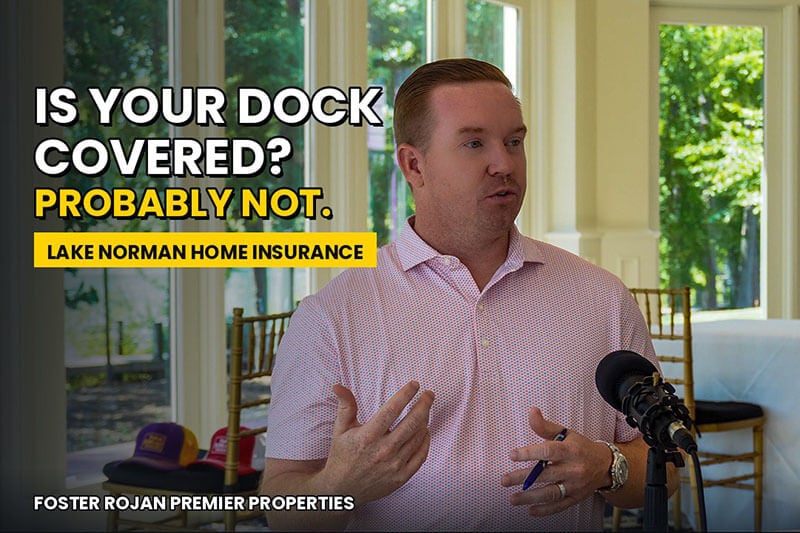
Property Insurance 101 with John Hassell | Lake Norman Real Estate
Jennifer Foster September 10, 2026
Jennifer Foster September 10, 2026
Here's a question that sounds like it has an obvious answer: if you own a $2 million home on Lake Norman, how much property insurance do you need?
Two million, right? Not necessarily. And depending on which direction you're off, you're either paying for coverage you'll never collect or you're going to find out the hard way that your policy can't rebuild your house.
We sat down with John Hassell of North Carolina Farm Bureau Insurance to walk through how this actually works — how carriers arrive at a number, what that number has to do with your lot (spoiler: almost nothing), and the handful of things around here that a standard policy treats very differently than you'd expect. Docks. Seawalls. That outdoor kitchen you spent all last spring building.
If you own on the water in Cornelius, Davidson, Mooresville, Huntersville, or Denver, this is the kind of thing that's easy to file under "I'll look at it later" until the day you can't. Grab your declarations page. This will take ten minutes and it's the most useful ten minutes you'll spend on your house this month.
The single biggest misconception, according to John, is that a home's market value tells you how much insurance it needs.
It doesn't. Insurance covers what it would cost to rebuild the structure — materials, labor, the works. It does not cover the land underneath it. And on Lake Norman, the land is doing an enormous amount of the heavy lifting on that sale price.
John's comparison is the clearest one we've heard: put a single-wide trailer on a $2 million lot, and you still have a $2 million lot. But the trailer might be worth fifteen thousand dollars. So fifteen thousand dollars is what gets insured.
Scale that up and it gets real. He described a scenario that's common out here — a $4 million home that's only three thousand square feet. Even at four to five hundred dollars a square foot, that's somewhere in the neighborhood of $1.2 to $1.5 million to rebuild. Not four million.
Why it matters: There are a lot of homes on this lake carrying dwelling limits that were quietly set by someone anchoring to the tax value or the purchase price. That's money leaving your account every month for coverage that can't be collected, because you can't burn down a lot.
Insider tip: Look at Coverage A on your declarations page. If that number looks suspiciously like what you paid, it's worth a phone call.
So where does the number come from? A residential cost estimator — software every carrier runs some version of.
Square footage goes in. Build quality goes in. So does everything else: the screened porch, the outdoor kitchen, the finishes. (John's shorthand for the high-end stuff around here is "the red knob stoves," which, if you've toured much inventory on this lake, you know exactly what he means.) The program spits out a rebuild figure, and that's the starting point.
For higher-value homes, Farm Bureau doesn't stop there. Anything under $1.5 million in insured value rides on the software. Above $1.5 million, they send an independent inspection company out to walk the house — actually inside, room by room.
And here's the part that surprised us: it doesn't always come back higher. John said he's had quite a few homes over the past year, several of them larger properties in the Point and Peninsula, where the estimator overshot by a hundred to a hundred and fifty thousand dollars. The inspector walked it and said, in effect, you don't need this much.
Why it matters: The inspection protects you in both directions. If the software says $1.6 million and the real number is $2 million, you have a problem you'd only discover after a total loss. If the software says $1.6 million and the real number is $1.45 million, you've been overpaying for years. Either way, you'd rather know now.
If you take one piece of vocabulary away from this, make it extended replacement cost.
Most carriers in North Carolina — John estimates around 90% — attach an endorsement that pays up to 125% of your dwelling limit. So a home insured for $1 million is effectively covered to $1.25 million. That buffer exists because construction costs don't sit still, and anyone who tried to build anything in 2021 remembers exactly how fast lumber can move.
A handful of outlier carriers offer true guaranteed replacement cost, which pays the full difference if rebuild costs spike mid-project. John was upfront that there are qualifying requirements on the back end — including an 80% coinsurance clause. Insure a million-dollar rebuild for $790,000 and you can find yourself holding an actual cash value policy, which is a very different animal.
His advice to homeowners, stripped of the technical layer: make sure you have at least 125% replacement cost on your policy. Every carrier out there offers it.
Why it matters: That 125% cushion is also what quietly absorbs the small stuff — the ten or fifteen thousand dollar bathroom refresh you didn't think to report. It is not, however, designed to absorb a full renovation. More on that in a minute.
Now for the part that's specific to living here.
A standard HO3 policy in North Carolina includes coverage for "other structures" — anything not attached to the house — at 10% of your dwelling coverage. So a million-dollar dwelling limit gives you a hundred thousand dollars for other structures.
Read that again with a Lake Norman eye. Your dock. Your outdoor kitchen. The shed out back. They are all sharing that one limit.
Anyone who's priced a dock replacement lately knows a hundred thousand dollars can disappear quickly, and John confirmed that some of the docks out here would blow past it if they were destroyed outright. He also noted the coverage is typically named-perils without additional endorsements — meaning it covers specific listed causes of loss, not everything.
Why it matters: This is the gap that catches people. Homeowners know they have "home insurance." Far fewer know their dock is riding on a percentage of a number they've never examined.
Insider tip: John mentioned that the real estate agents he works with are genuinely useful here, because good listing photos show him the whole property — the dock, the outdoor space, the shed — not just the front and back of the house. When you call for a quote, tell your agent everything that's out there. Endorsing it properly at the start is a much better conversation than discovering the limit afterward.
A few exclusions worth having on your radar, because they come up constantly on the water.
Flood isn't covered under a standard North Carolina homeowners policy. Neither is land movement — earthquake, mudslide, and the rest of that category.
Flood coverage is available separately, and John made a point we didn't expect: it's more affordable than most people assume. Very few of his Lake Norman clients carry it, largely because this is a man-made, dammed lake and the risk profile feels different than it would on the coast. Whether that math works for you is a personal call about risk tolerance, but it's worth knowing the option exists and isn't as expensive as you're picturing.
Seawalls are the tougher one. A failing seawall generally falls under erosion or land movement, which puts it outside an insurance contract — and John doesn't believe you can endorse your way around it.
As for docks and flood coverage specifically, he was refreshingly honest: he isn't certain the NFIP program pays for docks at all, and said flatly that it's a conversation to have rather than an assumption to make.
Why it matters: Seawall maintenance isn't an insurance question, it's a budget question. Treat it like a roof — something you inspect, plan for, and replace on your own timeline rather than a carrier's.
Every spring we watch it happen. Someone closes on a lake house, moves in, and within a month it's HGTV gone wild — walls coming down, quotes coming in, a dumpster in the driveway.
Almost nobody thinks to call their insurance agent.
John's guidance breaks into two buckets. Small cosmetic work in the ten to fifteen thousand dollar range? That's what the 125% buffer is there for. But a true renovation needs to be disclosed up front, when the policy is being written. A complete gut or a knockdown rebuild needs an entirely different type of contract altogether.
For a shorter renovation that can still ride on a homeowners policy, he'll ask you to insure the home for its future rebuild cost — the finished number, not today's. His example is blunt: if the house is insured at $500,000, the finished value is a million, and it burns halfway through, the payout is $500,000. Not $750,000. Yes, that means paying slightly more premium up front. That's the trade.
And call again when you're done, because the details move the number. Marble instead of carpet is, in his words, a big difference.
Why it matters: John was clear that it's the client's responsibility to report changes, not the agent's job to discover them. Nobody is driving by to check on your kitchen.
Here's a program we didn't know existed. Farm Bureau requires its agents to contact every client at their five-year renewal — then year ten, fifteen, twenty — and rerun the whole thing. Fresh residential cost estimator. Fresh photos of the house. A direct conversation about updates and added square footage.
John tries to review his clients' full package every two to three years on his own, though he was honest that it gets harder as a book of business grows. The five-year review, though, isn't optional for him. And as far as he knows, no other carrier requires it.
Why it exists is best explained by the example he gave: he pulled up to a home five years after writing it and found what looked like an entire second house attached to the original. The policy still carried $275,000 of coverage. The home was worth six hundred thousand. Nobody had called.
Why it matters: Whether or not your carrier makes anyone check in, five years is roughly how long it takes for a house to quietly become a different house. Additions, a new dock, a finished basement, a kitchen that's now nicer than the rest of the block.
Insider tip: Put a recurring calendar reminder on your policy renewal date. Fifteen minutes with your agent every couple of years is the cheapest insurance-related thing you'll ever do.
If you do nothing else after reading this: pull out your declarations page. Check that Coverage A reflects what it would cost to rebuild your home today, not what you paid for the lot and house together. Confirm you have at least 125% replacement cost. Then look at your other structures limit and ask yourself, honestly, whether it would cover your dock.
That's it. That's the whole assignment.
Big thanks to John Hassell at North Carolina Farm Bureau Insurance for walking us through it — this is one of those topics where a good local agent who understands lake property is worth every bit of the relationship. Contact John: https://www.ncfbins.com/john.hassell



At Foster Rojahn Premier Properties, we are the leading experts in Lake Norman real estate. We offer deep insights into the local market and are dedicated to helping you achieve your real estate goals.